


Why Luxury Is Doubling Down on Brick-and-Mortar


I was reading through the latest retail market reports the other morning over a black coffee, and a specific statistic stopped me completely, ninety-six luxury stores are scheduled to open across Europe over the next year, and they are doing it right in the middle of a massive economic downturn.
To the average financial analyst sitting behind a corporate spreadsheet, that looks like complete madness, it looks like reckless, blind optimism from luxury groups who simply refuse to read the economic room.
But if you understand the actual engineering of human behavior, it is the only retail strategy that makes any real business sense right now.
When the market contracts and inflation pinches, premium consumers do not stop spending entirely, they just get incredibly selective, they stop impulse-clicking on social media ads, they stop responding to digital marketing noise, and they completely stop converting on generic product landing pages.
Instead, they do something highly traditional, they get up, they walk into a physical store, and their nervous system makes a definitive decision within the first ninety seconds whether your brand actually deserves their money.
That decision has nothing to do with the logo stamped on the shopping bag, it is a subconscious calculation triggered by the solid texture of the floor under their feet, the precise angle of the light hitting the raw materials, the acoustic compression of the room, and whether the physical architecture makes them feel like they are stepping into an elite world worth paying for.
The Fragrance Gateway
Look closely at what the major fashion houses are doing with boutique fragrance spaces right now, they aren't building these high-sensory, immersive environments to move massive amounts of high-end leather goods, they are doing it to leverage a lower-barrier entry product.
A customer might hesitate to drop two thousand euros on a seasonal bag during a recession, but they will gladly spend two hundred euros on a premium fragrance if the environment where they buy it feels like an uncompromised, absolute brand universe.
It is a calculated, structural play to pull the consumer deep into the brand ecosystem and keep them there, giving them a physical, tactile reason to stay, to touch, and to experience the brand DNA in three dimensions.
In retail architecture, we talk a lot about layouts and aesthetics, but the truth is much simpler, dwell time is your real conversion rate, every extra minute a customer remains inside your store increases the mathematical probability of a transaction, and the only thing on earth that controls dwell time is the design of the space.
[Digital Ad Channels]  ──> High Ad Fatigue ──> Fast Bounce Rate ──> Wasted Acquisition Cost
[Sensory Architecture] ──> Subconscious Comfort ──> Extended Dwell Time ──> High-Ticket Conversion
Engineering the Ecosystem
The height of the ceiling, the fluid transition between retail zones, where the hero products sit in relation to the main entry threshold, and whether the architectural lighting makes a person feel calm or rushed, all of it is engineered, or at least, it should be.
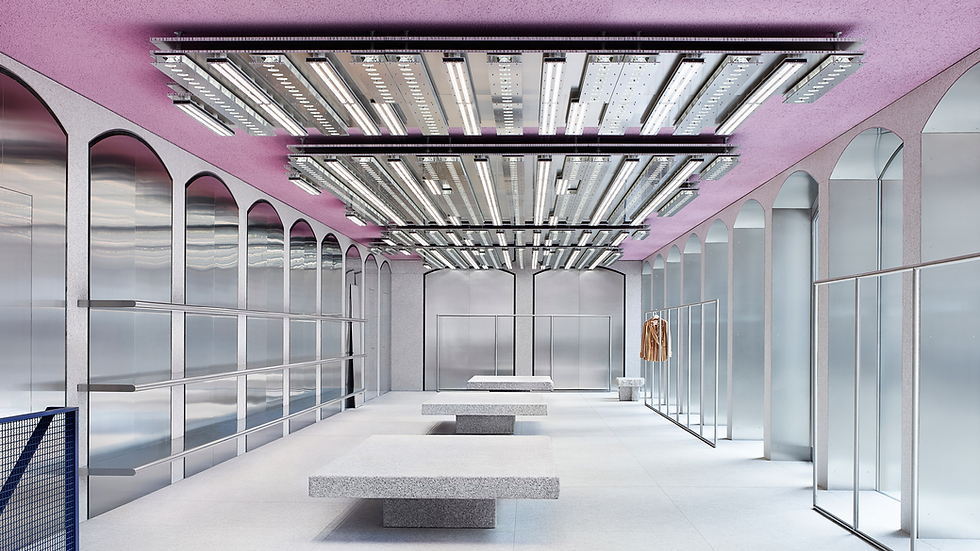
When we collaborate with international brands at SMN Design, drawing from our experience leading build-outs and construction management for names like Acne Studios, NIO, and Lynk&Co, we treat the floor plan as a strict risk-mitigation tool, because when budgets tighten, you cannot afford to design for design's sake, every single square meter must function as a high-performing business asset that actively justifies its CapEx.
The brands that survive this economic cycle will not be the ones that cut their physical footprints to double down on temporary Instagram ads, it will be the institutions that understood that when the screen fails to hold the consumer's attention, the physical room is the only thing left that can.
If you are a retail executive or creative director planning a premium rollout across Europe, let’s stop building safe, neutral containers that blend into the background. Let’s design an uncompromised spatial asset that performs.
Visit our selected commercial projects at smndesign.net or reach out to our studio directly to discuss the technical execution of your next flagship.

Comments